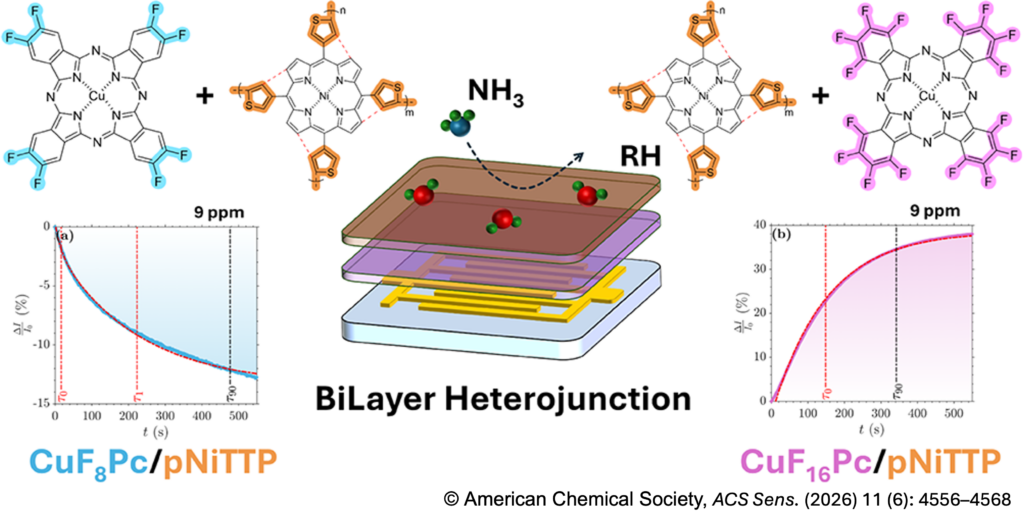
Researchers from ICMUB (CNRS/University of Burgundy Europe) and LIST (Luxembourg) have published a breakthrough in the detection of ammonia—a gas whose monitoring is essential for air quality and industrial safety—in ACS Sensors.
The study led by Prof. Marcel Bouvet (ICMUB) and Dr. Nicolas Boscher (LIST) focuses on the development of a double-layer sensor that combines phthalocyanine-type organic molecules with a porous polymer. This system enables the creation of sensitive, fast, and adaptable devices capable of detecting ammonia at extremely low concentrations (a few hundred parts per billion), with a response time of about one minute.
Thanks to their adjustable composition, these sensors adapt to changes in concentration and humidity, providing a robust solution for a variety of environments. This innovation paves the way for promising applications in the field of air quality control.
Read the article «Bilayer Heterojunctions of Phthalocyanines and Conjugated Microporous Porphyrin Polymers for High-Performance Ammonia Sensing » https://doi.org/10.1021/acssensors.5c04909